
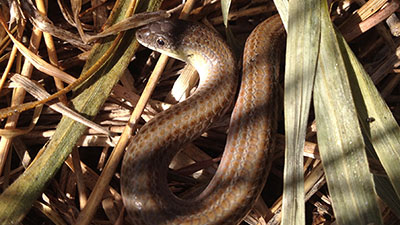
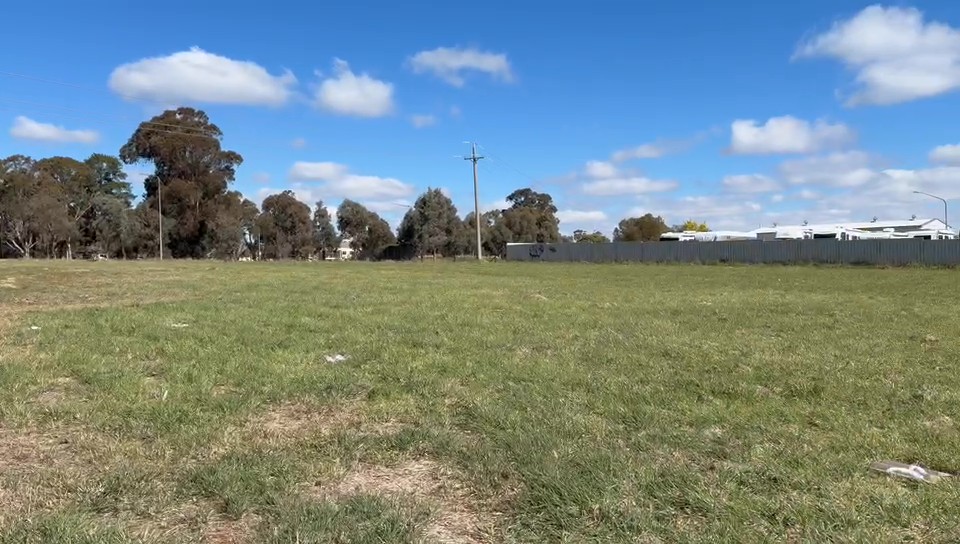
Our ecology team has commenced a Striped Legless Lizard (Delma impar) survey in a northern suburb of Canberra, establishing a long-term monitoring program to assess the presence of this nationally significant grassland reptile.
Listed as vulnerable under the the Commonwealth's Environment Protection and Biodiversity Conservation Act 1999 (EPBC Act), the Striped Legless Lizard is one of Australia's most threatened grassland species, and a matter of national environmental significance. Despite its snake-like appearance, Delma impar is a lizard, distinguished by its external ear openings and its ability to shed its tail when threatened.
In the Australian Capital Territory the species is known from four disjunct populations in Gungahlin, Yarramundi Reach, Majura Valley and the Jerrabomberra Valley, although the Yarramundi Reach population may now be extinct. Conserving the remaining populations is critical to the survival of the species in the region.
The Striped Legless Lizard spends much of its life concealed beneath dense grass tussocks, within soil cracks or under surface debris, and it does not bask in the open like other lizards. Traditional observation methods are therefore largely ineffective.
Instead, ecologists use artificial shelter tiles. Roof tiles absorb heat from the sun and create a warm microclimate underneath, an attractive refuge for reptiles and other small fauna seeking suitable ground-level temperatures.
Non-invasive, with minimal disturbance to native grassland habitat.
Cost-effective and repeatable over long-term monitoring programs.
A consistent method that can be compared across seasons and years.
Reduces the need for intrusive techniques such as extensive hand-searching or pitfall trapping.
Natural Temperate Grassland is one of the most cleared ecosystems in south-eastern Australia, and the Striped Legless Lizard depends on it entirely. Because the species is cryptic and easily missed, absence of records is not evidence of absence, so a defensible survey is the only way to know whether a population is present before land-use decisions are made.
Establishing the tile grid now creates a baseline that can be measured against in future years. That record supports our client's referral and approval obligations under the EPBC Act, guides where habitat should be retained or offset, and adds to the small pool of long-term data available for the species in the ACT.

The survey design was developed in close consultation with the ACT Conservator of Flora and Fauna, to ensure the methodology suited the site, was consistent with accepted survey practice, and was sensitive to the conservation significance of the species and its grassland habitat.
Senior Ecologist Gerard Dwyer and the field team set out a systematic grid across the study area, so that every tile can be monitored consistently over time.
Step 1: Assess the grassland to identify suitable habitat, avoiding sensitive vegetation and access issues.
Step 2: Establish grid alignment with a GPS, tape measure and field markers.
Step 3: Position tiles at regular intervals, each laid flat for good contact with soil and grass.
Step 4: Label and record every tile, so future observations match individual monitoring stations.
A tile grid only produces reliable data if it is installed and monitored consistently. Tile spacing, placement and the number of survey visits all influence detection, so a grid that is set out poorly can return an apparent absence at a site where the species is in fact present, with real consequences for the assessment that follows.
Working to a methodology agreed with the ACT Conservator of Flora and Fauna, recording every tile position and repeating the visits under suitable weather conditions means the results stand up to regulatory review, can be compared with surveys elsewhere in the ACT, and remain a valid baseline for anyone monitoring the site in future years.
The team will return in the coming weeks to begin the first of ten monitoring visits. During each survey the tiles are carefully inspected for Striped Legless Lizards and for other grassland fauna that may take up residence beneath them.
Results will be used to map the distribution of the species across the site, estimate relative abundance and better understand habitat use within the grassland. The findings will inform our client's development proposal while contributing data towards the conservation of one of the ACT's most significant threatened reptiles.

42 Goulburn Street Crookwell NSW 2583
34 Atchison Street Wollongong NSW 2500
Suite 4, 473 Townsend Street Albury NSW 2640
PO Box 3408 Manuka ACT 2603
We acknowledge Australia’s Traditional Owners and pay respect to Elders, past and present. We honour and celebrate the spiritual, cultural and customary connections of Traditional Owners to the country and the biodiversity that forms part of that country.

