

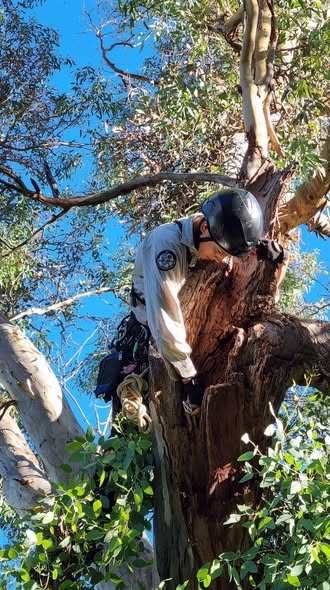
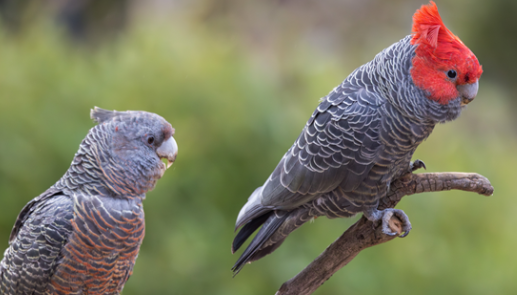
We know these iconic cockatoos need tree hollows to nest in, but a new study has found just how picky they are when choosing their nesting hollow.
The ANU researchers found that Gang-gangs like deep cavities with large entrances and ample floor space.
Using climbing surveys, we compared the characteristics of trees and cavities used by the endangered Gang-gang Cockatoo (Callocephalon fimbriatum) for nesting, with those of non-nesting trees and cavities in urban Canberra, Australia. The research team also evaluated the proportion of available cavities that meet the requirements for Gang-gang Cockatoo nesting and evaluated the reliability of ground-based cavity counts as a habitat assessment method.
The researchers found that Gang-gang Cockatoos used deeper cavities with larger entrance sizes and floor diameters than most available cavities in the study area, and nesting cavities were more likely to be found in trees with more cavities than non-nesting trees. Approximately 20% of unused cavities met the suitability criteria for Gang-gang Cockatoo nesting; ∼80% of those were located in trees already used for nesting.
Ground-based cavity counts were not a reliable method for determining the true number of cavities in trees as they consistently under- or overestimated cavity abundance relative to climbing surveys. These findings reinforce that animals can be highly selective in the cavities they choose to nest in and protecting known nesting trees is essential for maintaining breeding habitat for the Gang-gang Cockatoo.
The results reinforce the importance of protecting known nesting trees, and will help us to conserve these iconic, endangered cockatoos. Urban habitat management, including the removal of mature trees, may alter the availability of nesting habitat for cavity-nesters in urban landscapes. Effective retention of suitable nesting habitat requires species-specific data on nest-site requirements, which remain poorly quantified.
To read the study from The Australian National University (in collaboration with the ACT Government), visit https://doi.org/10.1093/jue/juag018
And to read and comment on the Recovery Plan, visit https://consult.dcceew.gov.au/draft-national-recovery-plan-for-the-gang-gang-cockatoo

42 Goulburn Street Crookwell NSW 2583
34 Atchison Street Wollongong NSW 2500
Suite 4, 473 Townsend Street Albury NSW 2640
PO Box 3408 Manuka ACT 2603
We acknowledge Australia’s Traditional Owners and pay respect to Elders, past and present. We honour and celebrate the spiritual, cultural and customary connections of Traditional Owners to the country and the biodiversity that forms part of that country.

