
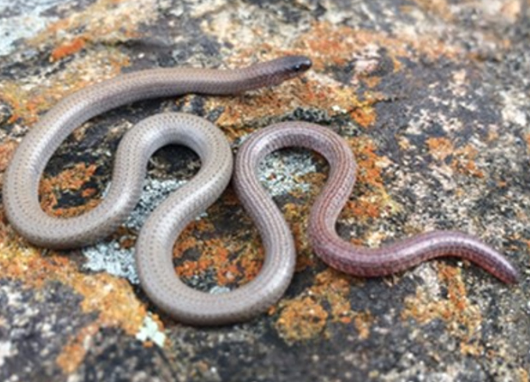
A new study provides a standardised approach to assessing pink-tailed worm lizard (Aprasia parapulchella) habitat suitability in NSW.
Under the NSW Biodiversity Offset Scheme, identification of habitat constraints is required to determine habitat for Aprasia. This replaces the need for targeted survey where a lack of detections does not confirm absence. Using information within this paper, environmental parameters can be determined to provide consistent interpretations for environmental impact assessment.
In Australia, a range of studies have been undertaken into the ecology and habitat requirements for the nationally threatened Aprasia parapulchella in the past 30+ years, with a primary focus on well-studied locations close to major population centres. Findings from these locations have biased the broad understanding of habitat and suitable survey techniques over time, with a focus largely on dacite geology and detection methods using rock-rolling under suitable environmental conditions.
However, the occurrence of the species in non-rocky environments and detectability challenges more generally suggests that established survey techniques are unlikely to provide confidence in survey outcomes across the species' geographical range over time.
For these reasons, the NSW Biodiversity Offset Scheme now utilises the process outlined in this paper to determine presence when assessing development impacts and offsets.
This study reviews key literature and spatial information to understand the broader habitat variability for Aprasia, document the range of habitats the species is known to occur in and produce an occupiable footprint and measurable habitat parameters to consider the potential for species occurrence. Information within this paper provides a standardised approach to assessing Aprasia habitat suitability in NSW.
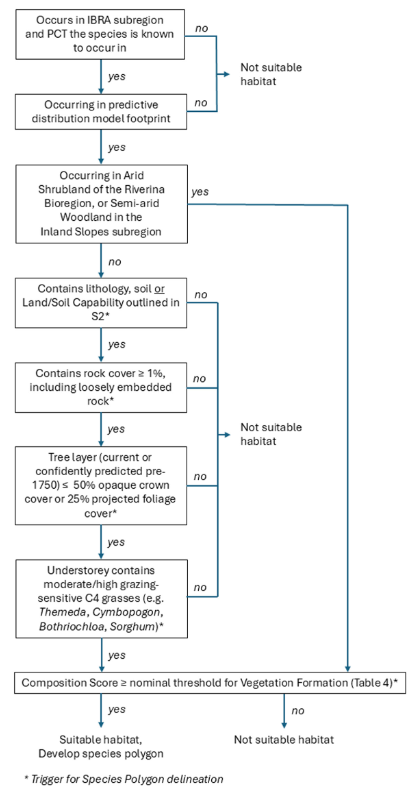
A decision tree was derived from the study results to determine suitable habitat for the purposes of the Biodiversity Assessment Method under the NSW Biodiversity Offset Scheme.
As part of this, assessment should include delineation of species polygons with factors considering substrate, rock cover (where relevant), tree cover and Compositional Score. If any part of a species polygon contains the minimum Compositional Score threshold, the entire polygon should be considered as habitat, or the polygon refined and further sampled to support amendment based on features in the decision tree.
The research report was prepared by staff at NSW DCCEEW, Charles Sturt University and Capital Ecology. The open access report is available to read online at: Ecological Management & Restoration Volume 27, Issue 3 (Sept 2026)

42 Goulburn Street Crookwell NSW 2583
34 Atchison Street Wollongong NSW 2500
Suite 4, 473 Townsend Street Albury NSW 2640
PO Box 3408 Manuka ACT 2603
We acknowledge Australia’s Traditional Owners and pay respect to Elders, past and present. We honour and celebrate the spiritual, cultural and customary connections of Traditional Owners to the country and the biodiversity that forms part of that country.

